I Can Write My Name Worksheet Vol-5
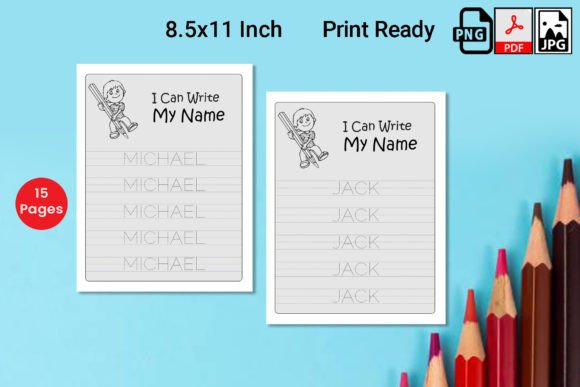
For educators, homeschooling parents, early childhood specialists, and creators building printable learning resources, I Can Write My Name Worksheet Vol-5 is a purpose-built word tracing practice worksheet designed to support foundational literacy development—without requiring lesson planning overhead. It’s not a standalone curriculum, but rather a precision tool: 15 ready-to-use pages that integrate cleanly into existing teaching workflows, KDP publishing pipelines, or classroom routines.
Where This Fits in the Learning & Creation Workflow
In a typical early literacy sequence, children move from letter recognition → letter formation → name writing → sight word tracing → independent spelling. I Can Write My Name Worksheet Vol-5 sits at the critical intersection of motor skill development and phonemic awareness—specifically targeting the “name writing” phase, which research shows strongly predicts later reading fluency and writing confidence.
Unlike generic tracing sheets, this volume focuses on personal relevance: each page invites the child to trace their own name alongside high-frequency words (e.g., “mom,” “dad,” “sun,” “cat”). That dual focus—personalization + functional vocabulary—makes it effective both as a warm-up before structured phonics instruction and as reinforcement after a guided reading session.
How to Use It Before, During, and After Core Activities
Before a lesson: Print one page and use it as a 3–5 minute activation task. Ask your child or student to say each word aloud while tracing—this primes auditory processing, articulation, and visual-motor coordination simultaneously. No prep needed; just open the PDF and go.
During independent work time: Assign one page per day across a two-week cycle. Pair tracing with a simple verbal prompt: “What sound does your name start with?” or “Can you find another word on this page that starts with the same sound?” This turns passive tracing into active phonological analysis—deepening retention without adding grading burden.
After assessment or observation: If a child struggles with letter reversals (e.g., b/d confusion) or inconsistent letter sizing, use the clean, no-bleed layout of I Can Write My Name Worksheet Vol-5 to isolate variables. The consistent baseline, generous spacing, and uncluttered design reduce visual distraction—letting you observe *how* they form letters, not just whether they complete the task.
Compatibility Across Tools, Platforms, and Roles
This resource delivers three file formats—PDF, JPG, and PNG—each serving distinct workflow needs:
- PDF (15 pages): Ideal for direct printing, classroom handouts, or embedding into digital learning platforms like Google Classroom or Seesaw (as downloadable assignments).
- JPG (15 pages): Optimized for quick uploads to Canva, PowerPoint, or lesson slide decks—useful when adapting the worksheet for projection or interactive whiteboard annotation.
- PNG (15 pages): Transparent-background versions let designers layer elements (e.g., add audio buttons in an interactive PDF, overlay animations in an app prototype, or integrate into custom flashcard sets).
All files are sized to standard 8.5 × 11 inches, bleed-free, and KDP-tested—meaning if you’re publishing your own workbook series on Amazon, these pages drop in without resizing, cropping, or formatting surprises. No manual margin adjustments. No trial-and-error alignment.
Practical Implementation Tips for Real Workflows
For educators building scope-and-sequence documents: Map each of the 15 pages to a specific weekly objective (e.g., Page 1 = capital letter formation, Page 7 = lowercase ‘a’ and ‘t’ consistency, Page 12 = blending /s/ + /u/ + /n/ while tracing “sun”). Because the content is intentionally repetitive yet progressively scaffolded, it supports spiral review—reintroducing concepts at increasing levels of independence.
For KDP publishers: These pages function as high-value interior assets. They’re unique and creative—not clip-art derivatives—so they differentiate your product in a crowded “preschool worksheets” category. Since they’re already print-ready and tested, you avoid common KDP rejections related to low resolution, incorrect dimensions, or bleed issues. That translates directly to faster time-to-market and fewer revision cycles.
For parents supporting remote learning: Keep the JPG files on a tablet. Use a stylus or finger to trace digitally—then switch to paper for tactile reinforcement. The dual-modality approach (digital + physical) accommodates different learning preferences and keeps repetition engaging.
Long-Term Usability and Quality Control
The absence of bleed isn’t just a technical detail—it’s a usability decision. It ensures crisp edges when printed on home printers or bulk-ordered through third-party vendors. And because every page follows the same structural logic (name first, then three supporting words, all in clear sans-serif font with consistent stroke width), children develop predictable expectations. That consistency reduces cognitive load—freeing mental bandwidth for skill acquisition instead of decoding layout.
Quality control extends beyond aesthetics. Each word was selected for its utility in early communication (“help,” “yes,” “go”) and its phonetic transparency—avoiding irregular spellings that could confuse emerging readers. There are no decorative distractions: no cartoon characters competing for attention, no extraneous borders or watermarks. What remains is pure function—designed to be used, not admired.
Integration Into Broader Resource Systems
I Can Write My Name Worksheet Vol-5 works best when treated as one node in a larger ecosystem—not a silver bullet, but a reliable connector. Pair it with:
- A simple progress tracker (e.g., a checklist where students color in a star after completing five pages)
- Audio recordings of each target word (for pronunciation modeling during tracing)
- Letter formation videos (to reinforce proper pencil grip and stroke direction before tracing begins)
- Your own assessment notes—jot observations directly on the printed sheet (e.g., “reversal on ‘b’,” “consistent starting point on ‘m’”)
This level of integration doesn’t require extra software or subscriptions. It relies only on how you choose to sequence, annotate, and reflect on usage—making it adaptable whether you’re a solo homeschooler or part of a district-wide early literacy initiative.
Why This Volume Stands Out Operationally
Many name-writing worksheets default to static templates: “Trace [Child’s Name]” with no variation. I Can Write My Name Worksheet Vol-5 avoids that rigidity. Its 15 pages offer built-in flexibility—you can assign them linearly, rotate based on student interest, or reuse select pages across multiple learners by simply editing the name field in the editable version (if included in your purchase tier). That adaptability supports differentiated instruction without extra prep time.
It also respects the reality of adult workflows: no login walls, no email gates, no forced updates. You download it once, store it locally or in cloud sync, and use it across devices, semesters, or school years. There’s no subscription decay, no feature lockout—and no need to relearn a new interface every time you return to it.
If you value tools that do exactly what they promise—without overcomplication, under-delivery, or hidden dependencies—I Can Write My Name Worksheet Vol-5 earns its place in your active toolkit. Not as decoration. Not as filler. But as a quietly effective lever in the daily work of helping young learners write their way into confidence, clarity, and competence.