Panda Coloring Book for Kids: A Strategic Asset for KDP Entrepreneurs
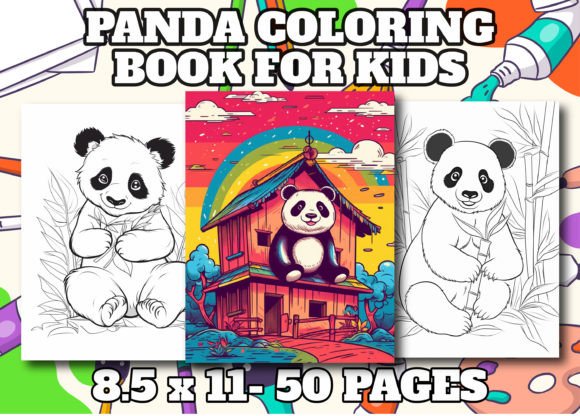
For creators building scalable, low-overhead Amazon KDP businesses, the Panda Coloring Book for Kids isn’t just another digital download—it’s a purpose-built, production-ready asset engineered for speed, quality, and market alignment. Unlike generic clipart bundles or hastily assembled PDFs, this collection delivers 50 high-resolution, print-optimized designs in three essential formats: JPG, PNG, and AI—each at 300 DPI, A4 (8.5” × 11”) dimensions. You receive a single .zip file containing all assets plus a professionally designed cover image, ready for immediate upload to KDP or integration into broader POD workflows.
Why This Design Set Fits Real Business Needs
Successful KDP publishing hinges on three interlocking priorities: time-to-market, visual consistency, and audience resonance. The Panda Coloring Book for Kids addresses each deliberately. Pandas carry strong cross-cultural appeal—gentle, non-threatening, instantly recognizable—and are consistently among the top-performing animal themes in children’s activity books. More importantly, these aren’t traced stock illustrations; they’re original line art with balanced negative space, clean contours, and age-appropriate complexity. That means fewer customer complaints about “too hard” or “too simple,” lower return rates, and higher organic visibility in Amazon’s algorithm—where engagement signals like page views per session and average session duration directly influence ranking.
From an operational standpoint, having 50 unique, high-DPI files eliminates the bottleneck of designing from scratch—or worse, outsourcing piecemeal to freelancers with inconsistent style or delivery timelines. You can test multiple book configurations (e.g., “Panda Friends,” “Panda Adventures,” “Panda ABC”) without redesigning a single line. That flexibility supports rapid iteration, which is critical when validating demand across niches like early childhood education, occupational therapy resources, or bilingual learning tools.
Strategic Use Cases Beyond the Obvious
While most buyers use the Panda Coloring Book for Kids as a standalone interior for a 50-page coloring book, its true strategic value emerges when treated as a modular system:
- Educational Extensions: Pair individual panda illustrations with vocabulary prompts (“Find the bamboo,” “Color the paws brown”), counting exercises, or emotion recognition cues—then compile into themed workbooks for preschool teachers or homeschool co-ops.
- Branded Product Lines: Use the AI vector files to extract elements (a paw, bamboo stalk, or panda face) and integrate them into matching sticker sheets, flashcards, or even printable reward charts—creating complementary SKUs that share visual DNA and boost average order value.
- Localization & Adaptation: Because the AI files are fully editable, you can easily adjust text placement, add bilingual labels (e.g., “panda / 熊猫”), or modify cultural context—enabling fast entry into Spanish-, French-, or German-language KDP markets without commissioning new art.
- Subscription or Membership Content: Release one panda design per week via email or a private portal, turning the collection into recurring value—not just a one-time sale. This builds trust and primes customers for future product launches.
What to Consider Before Deployment
High resolution and format variety don’t automatically guarantee success. Execution matters more than specs. Here’s what requires deliberate attention:
First, contextual positioning. A panda coloring book competes not only with other animal-themed books but also with broader categories like “mindfulness for kids,” “fine motor skill development,” or “screen-free activities.” Your title, subtitle, and backend keywords must reflect how parents and educators actually search—not just “panda coloring”—but phrases like “calming coloring pages for kindergarten” or “large print animal coloring book for toddlers.” The Panda Coloring Book for Kids gives you the visual foundation; your metadata strategy determines discoverability.
Second, cover design discipline. The included cover image is professional—but it’s a starting point, not a finish line. Test variations: Does a warm background increase perceived age-appropriateness? Does adding subtle texture (like watercolor grain) improve click-through rate in mobile thumbnails? Never assume the default cover will outperform alternatives. Use Amazon’s A+ Content or enhanced brand content to show interior spreads alongside usage suggestions (e.g., “Great for car trips, rainy days, or quiet time after school”).
Third, format integrity. While JPG and PNG files are ideal for KDP interiors, avoid upsampling or compressing them further. KDP’s print preview tool will flag pixelation or moiré patterns if you resize incorrectly. Stick to native 8.5” × 11” dimensions. If you need alternate sizes (e.g., 6” × 9”), rescale using vector-based AI files—not raster images—to preserve edge clarity.
Risks of Tactical Misuse
Using the Panda Coloring Book for Kids without clear goals introduces tangible business risk. Uploading all 50 designs as one massive 100-page book may seem efficient—but Amazon’s algorithm often favors focused, tightly themed titles. A 100-page “Panda + Zoo Animals” hybrid dilutes keyword relevance and confuses buyer intent. Similarly, releasing identical interiors under multiple pen names or ASINs violates Amazon’s duplicate content policy and invites suppression.
Another common misstep: treating the AI files as “infinitely reusable” without considering licensing scope. These files are intended for commercial use in physical/digital products you publish—but not for resale as standalone design assets, inclusion in subscription-based design libraries, or redistribution in editable templates sold elsewhere. Clarity here protects your account health and long-term access to KDP’s ecosystem.
Planning for Long-Term Leverage
The highest-return approach treats the Panda Coloring Book for Kids as the first node in a content architecture—not a finished product. Map backward from your 12-month goals: Do you aim to launch three themed activity books? Build an email list of early childhood educators? Establish authority in therapeutic coloring resources?
If your goal is authority, pair each uploaded book with a short, actionable blog post (e.g., “How Panda-Themed Coloring Supports Bilateral Coordination in Preschoolers”) and link to your KDP listing. That drives qualified traffic while signaling topical expertise to Google and Amazon alike.
If your goal is portfolio diversification, use the AI files to generate derivative assets: black-and-white line art for laser-cut stencils, SVG versions for Cricut users, or simplified versions optimized for tablet apps. Each extension reuses the same foundational investment—without requiring new illustration commissions.
Finally, track what works—not just sales, but which designs get pinned most on Pinterest, which interior pages generate the most customer photo uploads (a strong social proof signal), and which age brackets leave the most detailed reviews. That data informs your next acquisition: Should you invest in a koala or sloth set next? Or deepen the panda theme with seasonal variants (e.g., “Panda Winter Fun”)? Let real behavior—not assumptions—guide your roadmap.
Final Thought: Quality Is a Lever, Not a Given
Resolution, format count, and file type matter—but only when aligned with intention. The Panda Coloring Book for Kids delivers technical excellence precisely so you can focus on strategic decisions: who you serve, why they choose you over alternatives, and how each asset compounds toward sustainable growth. It removes friction from production so you can add value through curation, positioning, and thoughtful expansion. That shift—from executing tasks to designing systems—is where KDP ventures evolve from side hustles into resilient, scalable businesses.