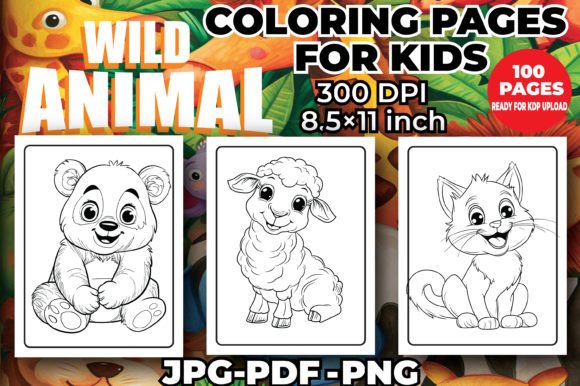
100 Wild-Animal Coloring Pages for Kids
The 100 Wild-Animal Coloring Pages for Kids is a digital download package designed for creators, educators, and self-publishers who need ready-to-use black-and-white illustrations of wild animals. It includes 100 interior coloring pages sized at 8.5″ × 11″, along with a set of 12 high-resolution book cover options. All files are provided in multiple industry-standard formats: EPS (vector), PDF, JPG, and PNG — each at 300 DPI resolution to support professional printing.
This resource is intended primarily for users preparing books for platforms like Amazon KDP (Kindle Direct Publishing). The pages are grayscale line art, optimized for coloring by children aged approximately 4–10 years. Subjects span global wildlife — including mammals, birds, reptiles, amphibians, and insects — drawn with consistent line weight and clear silhouettes to support fine motor development and creative engagement.
Who Might Consider This Resource?
Educators, homeschooling parents, and activity-book designers may evaluate the 100 Wild-Animal Coloring Pages for Kids when seeking efficient, print-ready assets for classroom use or commercial publication. Independent authors building themed activity books — such as “Wildlife Explorers,” “Zoo Keepers’ Journal,” or “Endangered Species Coloring Book” — often look for cohesive, scalable illustration sets that reduce design time and licensing complexity.
Because the package includes both vector (EPS) and raster (PDF, JPG, PNG) files, it accommodates varying technical comfort levels. Users familiar with Adobe Illustrator can edit individual elements; those using Canva or basic desktop publishing tools can work directly with the PDF or JPG versions.
Key Benefits
- Format flexibility: EPS files allow resizing without quality loss, while 300 DPI JPG and PNG files ensure sharp output on physical printers and KDP’s automated workflows.
- KDP readiness: Pages match standard US letter size and require no layout adjustments before upload — reducing prepress time.
- Consistent visual style: Uniform linework and composition across all 100 pages support branding and readability, especially important for series development.
- Time efficiency: Eliminates the need to source, license, or commission individual illustrations — useful when launching multiple titles or working under deadline.
Tradeoffs and Considerations
While the collection offers breadth and technical readiness, it does not include editable text layers, educational annotations, or species-specific facts. Users aiming to produce curriculum-aligned materials — for example, science-backed activity books with habitat maps or conservation notes — will need to supplement the illustrations with original content or licensed reference material.
The animals depicted follow general stylistic conventions rather than anatomical precision. For projects requiring scientific accuracy — such as field guides or biology workbooks — additional verification or custom illustration may be necessary. Likewise, the absence of cultural context (e.g., Indigenous names, regional conservation status) means educators intending culturally responsive lessons will need to integrate those elements separately.
Although all images are black-and-white and suitable for coloring, they do not vary in difficulty level. The set includes no progressive skill scaffolding — such as simplified outlines for younger children or intricate patterns for older ones. Users targeting mixed-age groups may need to curate or modify pages manually.
When This May Be a Strong Fit
The 100 Wild-Animal Coloring Pages for Kids aligns well with goals centered on speed, consistency, and platform compliance. It is especially appropriate for:
- Self-publishers launching their first KDP coloring book and prioritizing straightforward file preparation over customization.
- Small studios producing themed activity bundles (e.g., “Nature Discovery Pack”) where visual cohesion matters more than species-level specificity.
- Teachers creating supplemental handouts for units on ecosystems, animal classification, or geography — assuming supplementary text and context are added externally.
- Designers needing fallback assets while awaiting commissioned artwork, or testing market response before investing in bespoke illustration.
When Alternatives May Be Worth Considering
Users with specialized requirements may find other solutions more suitable. For instance:
- Educational publishers developing standards-aligned resources may prefer licensed clip art libraries offering pedagogical metadata (e.g., NGSS tags, reading-level indicators) or customizable infographics.
- Illustrators or brands building distinctive visual identities may prioritize original artwork to avoid similarity with other KDP titles using the same asset pool.
- Non-US publishers targeting A4 markets should verify whether the 8.5″ × 11″ dimensions require cropping or reformatting — though PDFs can typically be adjusted without quality loss.
- Accessibility-focused creators aiming for inclusive design may seek illustrations with higher contrast, simplified shapes, or tactile-enhancement guidance — features not specified in this package.
Making an Informed Decision
Before acquiring the 100 Wild-Animal Coloring Pages for Kids, assess your project’s core needs against three practical criteria:
- Technical scope: Do you require vector-editable files, or will print-ready PDF/JPG suffice? If editing is essential and you lack vector software, confirm compatibility with your tools.
- Content depth: Does your use case rely primarily on visual appeal, or does it depend on biological accuracy, cultural relevance, or pedagogical structure? The latter may necessitate pairing this set with original writing or expert review.
- Distribution channel: If publishing outside KDP — such as via IngramSpark, local printers, or school districts — verify whether file specifications (e.g., bleed, margins, color profiles) meet those platforms’ requirements.
Reviewing a sample page — if available — helps gauge line clarity, spacing, and age appropriateness. Also consider how the included covers integrate with your branding: the 12 JPG options provide variety, but none include editable text fields, so title and subtitle placement must be handled separately.
Ultimately, the value of the 100 Wild-Animal Coloring Pages for Kids lies in its balance of utility and accessibility. It serves as a functional foundation — not a complete solution. Its strength emerges not in isolation, but when matched thoughtfully to a creator’s workflow, audience needs, and long-term publishing strategy.