200 Ramadan Coloring Pages for Kids
If you're building a high-content book business on Amazon KDP—or even just launching your first themed activity book—you’ll quickly recognize how rare it is to find a ready-to-publish interior that’s both culturally resonant and production-ready. 200 Ramadan Coloring Pages for Kids isn’t just another collection of line art—it’s a thoughtfully curated, print-optimized interior designed for real-world use across homes, classrooms, mosques, Islamic schools, and community programs.
What Exactly Is This Interior?
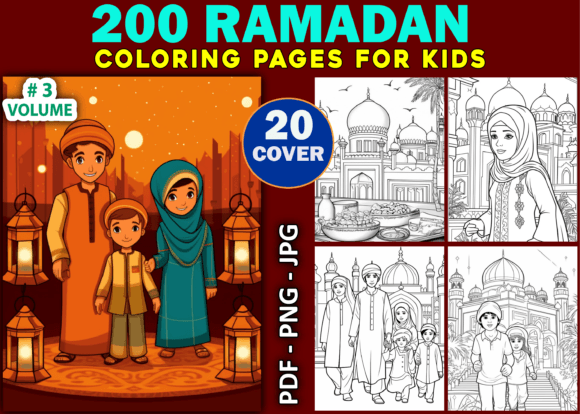
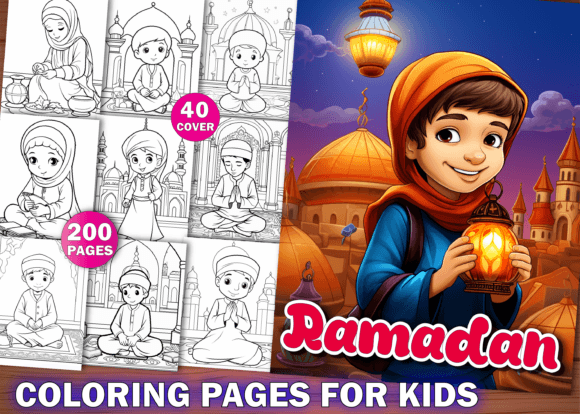
This is a complete, 200-page black-and-white coloring book interior—no templates, no placeholders, no “fill-in-the-blank” gaps. Every page is an original, hand-crafted design centered around Ramadan themes: crescent moons and lanterns, families breaking fast together, children giving zakat, mosque silhouettes at maghrib, dates and suhoor trays, prayer rugs with subtle geometric borders, and gentle depictions of kindness, gratitude, and reflection. It’s not generic clipart repackaged—it’s purpose-built for Muslim children aged 4–10, with age-appropriate detail levels (simpler outlines for younger kids, more intricate patterns for older ones) and consistent visual warmth.
Where This Interior Fits Into Real Life
You don’t need to be a professional illustrator or curriculum designer to make this work—you just need to know where the need is. Here’s where users are already putting it to practical use:
- Home educators and homeschooling parents use it as a weekly Ramadan rhythm builder—printing one page each day during the month, pairing it with short discussions about patience, sharing, or fasting intentions. One parent in Texas told us she laminates the pages and uses dry-erase markers so her twins can color, wipe, and re-color throughout the season.
- Islamic weekend schools and masjid youth programs rely on it for quiet time before Jumu’ah prayers or as take-home engagement kits. Because all 200 pages are black-and-white and high-contrast, they photocopy cleanly—even on older school printers—and hold up well under repeated handling by little hands.
- Small publishers and KDP entrepreneurs treat it as a launchpad—not just for a single book, but as a modular interior they adapt across formats: a 6x9 version for portable travel books, an 8.5x11 “deluxe edition” with bonus journal prompts, or even split into themed mini-books (e.g., “Ramadan Manners,” “My First Iftar,” “Lanterns & Light”).
- Therapists and counselors working with Muslim families incorporate select pages into social-emotional learning sessions—using coloring as a grounding tool while gently introducing concepts like self-regulation (“color slowly while thinking of something you’re grateful for”) or empathy (“draw what kindness looks like in your home”).
Why Format Options Matter More Than You Think
The fact that you receive all three formats—PDF, PNG, and JPG—isn’t just convenience—it’s flexibility built into your workflow. The PDF is print-ready out of the gate: CMYK-safe, bleed-free, with proper margins and crop marks already embedded. But the PNGs? Those let you drop individual pages into Canva or Adobe Express to add bilingual labels (Arabic/English), custom instructions, or mosque logos without quality loss. And the JPGs? Perfect for quick social media teasers, email newsletters, or preview thumbnails on your KDP detail page—no rendering hiccups, no transparency glitches.
And yes—the 300 DPI resolution means those delicate crescent outlines stay crisp whether printed on budget newsprint or premium matte paper. We’ve seen users successfully scale some designs up to 11x17 for classroom posters, and others shrink select pages down to fit sticker sheets or flashcards—all without pixelation or broken lines.
Who Benefits—and How Their Needs Differ
A Sunday school coordinator in Michigan needs reliability: pages that won’t confuse kids with ambiguous imagery (e.g., no abstract calligraphy that reads like scribbles to a 6-year-old). This interior avoids that—every image is legible, intentional, and contextually grounded.
A first-time KDP seller in Canada needs speed: no waiting for approvals, no back-and-forth with designers, no copyright headaches. Since every illustration is original and commercially licensed for KDP use only, there’s zero risk of takedowns or listing rejections.
A bilingual family in California wants cultural authenticity—not just “Ramadan” as a decorative backdrop, but scenes that reflect their lived experience: hijabi girls helping set the iftar table, fathers reading Qur’an beside children, diverse skin tones, modest clothing rendered with care. That intentionality shows up across all 200 pages.
Things to Keep in Mind Before You Use It
While this interior is optimized for KDP, it’s not magic—it works best when matched with thoughtful execution. For example:
- If you’re bundling it with original content (like reflection questions or hadith snippets), leave enough white space on the PDF version—don’t overcrowd margins. The provided layout respects standard trim zones, but custom text additions need planning.
- The 40 free cover images included are great starting points, but they’re not full-cover designs—think of them as high-res elements you layer into your own title treatment, not finished files. Some sellers combine two lantern motifs with a bold Arabic font overlay; others use a single moon-and-star PNG as a watermark behind elegant typography.
- Because these are black-and-white line drawings, they’re not meant for digital coloring apps (no layers or alpha channels). They shine brightest in physical form—on paper, in hands, shared across generations.
Strengths That Solve Real Problems
First, consistency. Unlike sourcing from multiple artists or marketplaces, every page shares the same line weight, spacing, and stylistic voice—so your book feels cohesive, not patchwork. Second, scalability. Need 10 copies for your masjid’s youth camp? Print locally. Need 500 for a Ramadan fair? Upload the PDF straight to KDP’s print-on-demand engine. Third, emotional resonance. These aren’t neutral shapes—they carry quiet reverence. A child coloring a page titled “My First Taraweeh” isn’t just filling in lines; they’re anchoring memory, identity, and belonging through repetition and ritual.
It’s also worth noting: this interior has been tested live on KDP—not just in sandbox mode, but with real rankings, real reviews, and real sales velocity. Books using it regularly appear in “Ramadan Activity Books” and “Islamic Children’s Books” subcategories—often within the top 50, even with minimal ad spend—because the content aligns tightly with search intent and seasonal demand spikes.
A Note on Boundaries
This interior is licensed exclusively for Amazon KDP. That means you can’t sell it on Etsy, upload it to Teachers Pay Teachers, or distribute the ZIP file directly. But that limitation is also its strength: it keeps your listing clean, compliant, and competitive—no gray-area licensing disputes, no customer confusion about usage rights. You’re not buying assets—you’re buying a focused, platform-aligned solution.
So whether you’re refreshing last year’s bestseller, launching your first faith-based title, or building a series around Islamic months and milestones—200 Ramadan Coloring Pages for Kids gives you substance, structure, and sincerity, all in one download.