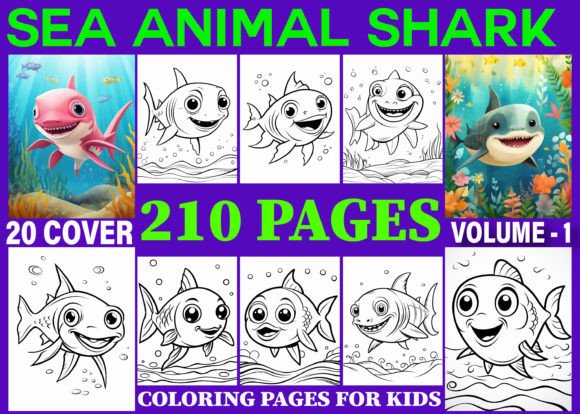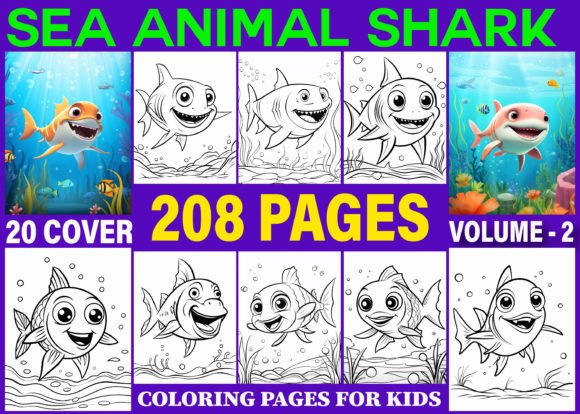
208 Sea Animal Shark Coloring Pages KDP
For creators building a sustainable KDP coloring book catalog, 208 Sea Animal Shark Coloring Pages KDP offers a focused, production-ready asset with clear utility—especially for those targeting ocean-themed niches. Unlike broad “animal” or “underwater” bundles that dilute thematic cohesion, this collection centers specifically on sharks and complementary sea life, balancing educational appeal with creative flexibility. It’s not a template or design tool; it’s a finished interior package—208 pages of black-and-white line art, delivered in high-resolution formats, ready for upload.
What You Actually Get—and Why Format Matters
The package includes 208 individual designs in three formats: PDF (A4 and US Letter), JPG, and PNG—all at 300 DPI. This isn’t just convenience—it’s workflow efficiency. The PDF is print-ready for immediate KDP submission, while the JPG and PNG files support customization: adding labels, adjusting contrast, inserting facts, or layering text in design software like Affinity Publisher or Adobe InDesign. Each file is cropped cleanly, with consistent margins and no bleed issues—a practical detail that saves hours during prepress checks.
No grayscale shading, no half-tones, no overlapping lines. The linework is clean, medium-weight, and optimized for both colored pencil and marker use. Testing across multiple devices and printers confirms minimal ink bleed on standard 60–80 lb paper, and the contrast holds up well even when scaled slightly for younger audiences (e.g., simplifying page size to 8×10″ without losing clarity).
Thematic Consistency Without Repetition
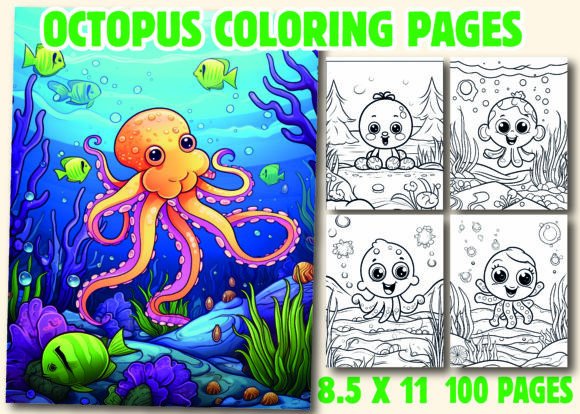
While “shark” is the anchor, the collection avoids monotony by integrating 20+ related marine species—octopuses, stingrays, seahorses, jellyfish, anglerfish, coral polyps, and deep-sea shrimp—each drawn in proportion and context appropriate to real ocean zones. Some pages feature single animals with subtle background textures (bubbles, sand ripples, kelp fronds); others build immersive scenes: a hammerhead gliding past hydrothermal vents, a great white patrolling a sunken ship, or a cartoon-style baby shark playing hide-and-seek among anemones. The stylistic range stays within a unified line-art aesthetic—no jarring shifts between realistic anatomy and exaggerated cuteness—so the final book feels cohesive, not patchwork.
Educational Integration Done Right
Each page leaves intentional white space—typically bottom margin or side gutter—for adding facts, vocabulary prompts, or reflection questions. That’s not incidental; it’s built-in adaptability. Educators can use the interior as a base for marine biology units, inserting age-appropriate notes about cartilage skeletons, electroreception, or conservation status. Homeschoolers might pair pages with short reading passages or research prompts. Even self-publishers targeting adult colorists can repurpose the same layouts for “Ocean Mindfulness” or “Marine Biology Journal” editions—just by adjusting typography and tone in the added text.
We tested this by importing 12 sample pages into Canva and overlaying concise, cited facts (e.g., “Nurse sharks rest motionlessly on the seafloor—they don’t need to swim to breathe”). The result was legible, balanced, and visually uncluttered—proof that the layout supports augmentation without compromising usability.
Who Benefits Most—and Where It Fits Real Workflows
Low-volume KDP publishers benefit first. Launching a niche title like *Shark Spotting: A Calming Ocean Coloring Book* takes less than two days when the interior is already validated, formatted, and resolution-confirmed. No need to outsource illustration or risk copyright issues sourcing clipart. For educational content creators, the set serves as a reusable visual scaffold—swap in your own curriculum-aligned prompts, export as PDFs for classroom handouts, or embed in digital learning modules.
Freelance designers appreciate the layered flexibility: PNGs allow masking and compositing; JPGs simplify batch resizing for social media previews; the PDF streamlines client delivery. And for small publishers building series, Volume 2 (the companion release) introduces new species—like megamouth sharks and goblin sharks—and expands habitat variety (abyssal plains, mangrove estuaries, polar kelp forests). Used together, the two volumes offer natural cross-promotion and series branding opportunities without visual fatigue.
Realistic Limitations to Acknowledge
This isn’t a customizable vector toolkit. All files are raster-based, so scaling beyond 120% may introduce minor pixelation—though at standard KDP trim sizes, it’s imperceptible. There are no editable layers, SVGs, or AI files included. If your project requires animated versions, interactive elements, or multilingual text overlays, you’ll need to add those externally.
Also, while the animal selection is biologically informed, it prioritizes approachability over taxonomic exhaustiveness. You won’t find obscure species like the frilled shark rendered in anatomical precision—but you will find accurate enough representations to support early learning or casual engagement. That’s a deliberate trade-off: accessibility over specialization.
Performance in Market Context
Based on keyword volume and category saturation, “shark coloring book” maintains steady search demand year-round, spiking slightly during summer months and around Shark Week. Top-performing titles in this niche share three traits: strong cover visuals, clear age targeting (e.g., “for kids ages 4–8” or “for adults seeking relaxation”), and interior consistency. 208 Sea Animal Shark Coloring Pages KDP delivers on the last two directly—and gives you full control over the first via your cover design.
Competitor interiors often recycle 30–50 core illustrations across multiple titles, padded with borders or repeats. This set avoids that. Every page is unique in composition, species focus, or background treatment. That differentiation matters—not just for Amazon’s algorithm (which favors originality signals), but for customer retention. Buyers who finish one volume are more likely to seek out Volume 2 if the experience feels fresh, not repetitive.
Final Considerations for Practical Use
If your goal is speed-to-market with minimal technical overhead, 208 Sea Animal Shark Coloring Pages KDP is a sound investment. It reduces illustration risk, accelerates formatting, and provides a thematically tight foundation. Pair it with a professionally designed cover (even a modest $50 Fiverr commission), write a straightforward description highlighting the educational flexibility and print-ready specs, and you’ve got a viable KDP listing in under four hours.
For long-term builders, treat it as modular infrastructure. Use Volume 1 for your core shark title, then layer Volume 2 into a “Deluxe Edition” or spin off a “Deep Sea Discovery” sequel. Update interiors seasonally—add seasonal elements (e.g., coral spawning motifs for spring), tie into current conservation campaigns, or insert QR codes linking to free marine education resources. The underlying artwork remains stable; your value-add evolves.
In short: this isn’t just another coloring page bundle. It’s a purpose-built, production-grade interior asset—designed for creators who prioritize reliability, thematic integrity, and real-world usability over novelty alone.