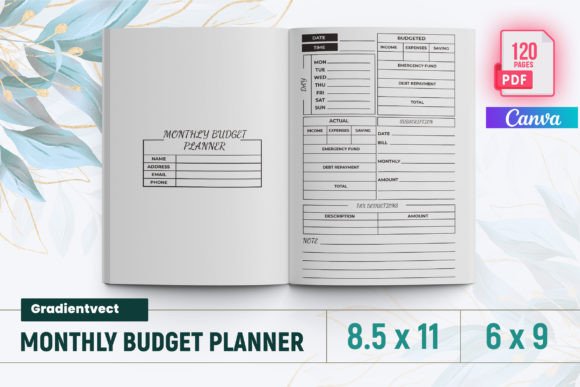
KDP Monthly Budget Planner Canva
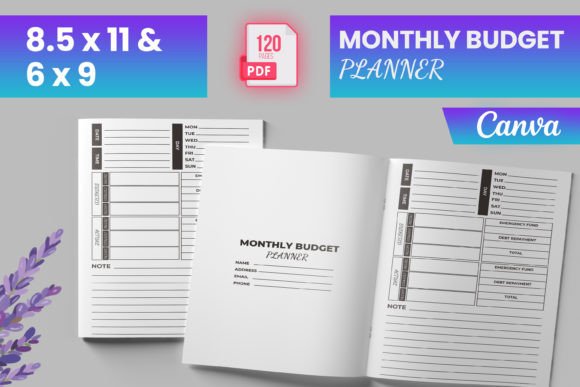
For creators, entrepreneurs, freelancers, and small business owners building income streams through Kindle Direct Publishing (KDP), the interior design of a planner isn’t just about aesthetics—it’s about function, compliance, and speed to market. The KDP Monthly Budget Planner Canva is built for this exact reality: a ready-to-upload, bleed-ready interior that meets Amazon’s strict formatting requirements while delivering real utility across personal finance, expense tracking, and goal-based budgeting.
This isn’t a generic printable—it’s a production-ready KDP interior designed from the ground up for publishers who value precision over padding. Whether you’re launching your first budgeting workbook or scaling a series of financial planners, the KDP Monthly Budget Planner Canva eliminates guesswork in layout, sizing, bleed setup, and page count alignment—so you spend less time troubleshooting and more time publishing.
How It Fits Into Your Publishing Workflow
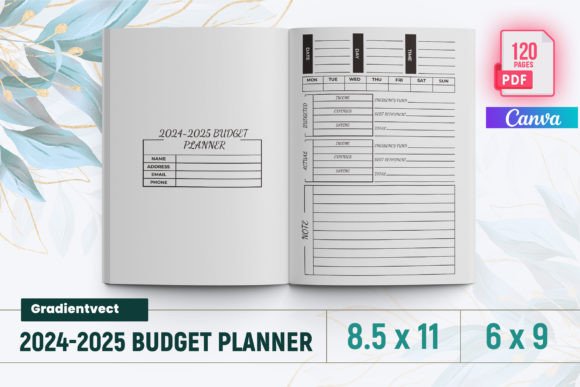
The KDP Monthly Budget Planner Canva functions best when treated as a production asset—not a starting point for design exploration, but a validated foundation for execution. Before uploading to KDP, you’ll use the included PDF file to confirm trim size (8.5" × 11"), total page count (120 pages), and bleed margins (0.125" on all sides). These specs were tested directly on Amazon’s previewer and print-on-demand system, meaning no last-minute reformatting after rejection.
During creation, you’ll work inside Canva using the provided PNG and JPG files as visual references—especially useful when customizing cover art, adjusting color schemes, or aligning branding elements like fonts and icons. Because the interior includes labeled sections (Debt Payment Tracker, Annual Finance Overview, Shopping List, etc.), you can map content updates precisely without disrupting page flow or KDP’s spine calculation.
After publication, the planner becomes part of your reader’s daily workflow—not just as a passive tool, but as an active component of their financial rhythm. Users rely on the KDP Monthly Budget Planner Canva-based interior for weekly planning sessions, monthly reviews, and quarterly financial check-ins. Its structure supports consistency: each month begins with an intro page, followed by dedicated spreads for income, expenses, savings goals, bill tracking, and reflection prompts—all organized to reduce decision fatigue and reinforce habit formation.
Integration With Other Tools and Systems
The KDP Monthly Budget Planner Canva doesn’t replace spreadsheet-based forecasting or banking apps—but it complements them. Think of it as the “human layer” between raw data and intentional action. For example:
- A freelancer syncing QuickBooks income reports might transfer totals into the Income Tracker spread every Friday, then use the Saving Jar section to allocate percentages toward specific goals (e.g., equipment fund, emergency reserve).
- An educator preparing a personal finance workshop could extract the Financial Calendar and Monthly Bill Tracker pages into handouts—retaining the clean, accessible layout while adapting language for classroom use.
- A small business owner managing side-hustle cash flow might pair the Shopping List and Money Saving Planner pages with a shared Google Sheet, using the planner for ideation and the sheet for collaborative editing and reminders.
Because the interior includes both structured trackers (like the Expense Tracker) and open-ended spaces (such as reflection prompts on the Intro Page), it adapts naturally to hybrid workflows—digital-first users print selectively; analog-first users scan completed pages into note-taking apps like Notion or Obsidian for long-term analysis.
Practical Implementation Tips
To get full value from the KDP Monthly Budget Planner Canva, start with preparation—not decoration. Before opening Canva or editing any file, clarify your target audience’s primary pain points: Are they overwhelmed by irregular income? Struggling to visualize annual spending trends? Consistently overspending on groceries? Let those needs guide how you position the planner—not as a one-size-fits-all solution, but as a tailored response.
When customizing, prioritize readability over novelty. Use high-contrast text, avoid decorative fonts in data-entry areas, and maintain consistent spacing between rows in trackers. The included PNG and JPG files serve as quality benchmarks—if your edits introduce pixelation, misalignment, or inconsistent margins, revert to the original assets and adjust layers instead of resizing raster elements.
For long-term usability, treat page organization as non-negotiable. The 120-page count includes intentional pacing: 12 monthly spreads (10 pages each), plus supplementary tools like the Debt Payment Tracker and Annual Finance Overview. Don’t compress or remove pages to cut costs—KDP’s printing algorithm relies on predictable pagination for proper binding and bleed handling. If you need to add branding, do so in header/footer zones that don’t interfere with functional areas.
Quality Control and Consistency Across Editions
Because the KDP Monthly Budget Planner Canva was tested on live KDP systems, it serves as a reference standard for future iterations. When expanding your planner line—say, adding a quarterly version or debt-focused spin-off—use this interior as your baseline for bleed setup, margin allowances, and font sizing. That consistency builds reader trust: someone who bought your monthly edition knows exactly what to expect from your annual or minimalist editions.
Also consider version control. Save your Canva project with clear naming (e.g., “KDP-Monthly-Budget-Planner-v2-2024-Q3”) and export final PDFs with embedded fonts and flattened layers. This avoids rendering issues during KDP’s automated preflight checks—and ensures that if you ever need to re-upload due to Amazon policy changes, your file remains compliant without redesign.
Efficiency Gains You’ll Notice Immediately
Time saved isn’t abstract—it’s measurable. With the KDP Monthly Budget Planner Canva, you skip:
- Manually calculating bleed and safe zones for 120 pages.
- Testing multiple PDF exports to find one that passes KDP’s previewer.
- Rebuilding tracker tables from scratch for each new planner.
- Guessing at optimal line height and column width for handwritten input.
That adds up to hours reclaimed per title—time better spent refining your marketing copy, analyzing sales data, or engaging with readers in your niche. And because the interior includes functional diversity (from Shopping List to Financial Calendar), you’re not just shipping a planner—you’re delivering a cohesive financial operating system that encourages repeat engagement and cross-selling opportunities.
Real-World Use Cases Across Audiences
A marketer launching a course on financial literacy uses the Money Saving Planner and Budget Planner spreads as downloadable bonuses—customized with her brand colors and logo, then distributed via email opt-in. A blogger documenting her debt payoff journey prints the Debt Payment Tracker and Saving Jar pages monthly, shares progress screenshots, and links to her KDP edition for followers wanting the full toolkit. A freelance graphic designer bundles the KDP Monthly Budget Planner Canva interior with a custom cover and editable Canva template as a premium product—offering clients both print-ready files and flexible digital customization.
In each case, the strength lies not in novelty—but in reliability. Readers return because the planner works as promised: no blank pages where calculations should be, no missing months, no confusion around where to write dates or amounts. That reliability compounds over time, turning first-time buyers into series subscribers and casual users into community advocates.